The many faces of Koishi Komeiji
From the perspective of someone that now has to start writing about it for this post, it’s a little hard to describe Touhou Project without having to resort to terminology like ‘fandom’ that is often used as a derogatory word.
In a vacuum it is a long-running bullet hell arcade game series about Japanese mythology. But Touhou’s rich history throughout the international hodgepodge that is the Worldwide Web presents a rabbit hole so deep it’s hard to imagine it is still a niche franchise all things considered. … Maybe not that niche. Anyone in their 20’s that has been on the internet for half of their life has more-or-less acknowledged its existence even if they hadn’t initially recognize it. But good luck trying to talk to your coworker about any character who isn’t Reimu or Cirno.
Touhou has been the subject of derivative works, as well as turbo nerd arguments surrounding such works, for a very long time now. Through interpretations, due to the author’s intentions or from language barriers, its cast have seen many different forms of characterization to the point that the line between canon and ‘fanon’ has been blurred.
But is this really as bad as some of the more dedicated fans of the franchise suggest it is? Can parody provide any value to its reference material, or can it only detract from it?
You met me at a very himedanshi time in my life
Touhou had only recently caught my attention about two years ago when I inadvertently followed a super fan on Twitter back when there were more people on that site than just the American neo-nazi or botted crypto scammers. Eventually, the exposure sort of fell onto my lap and after picking up Imperishable Night out of a blind bag of a dozen other entries I quickly became infatuated with the world of Gensokyo.
And also the copious amounts of yuri, but that’s besides the point.
Distilled, Touhou is a series of stories taking place in Gensokyo, a paradise world of youkai and other mythological beings where, every now and then, an incident threatens the balance of the land and it’s up to the Hakurei shrine maiden (or whoever else is getting dragged along) to fix it.
Touhou's developer Jun'ya Ōta, or "ZUN", had created this world not only as a grab bag of Japanese mythology, but as sort of a baseplate for continued storytelling. This is further realized by his hands-off approach with the finer details of the lore, instead opting to share alcohol-inspired trivia every now and then to keep discussions interesting. Every character has a dynamic personality, their own lives to live (whenever they’re not trying to shoot each other with magic bullets), and have relationships both positive and negative with one another.
Naturally, a large community would surround the franchise, and with it came several decades worth of derivative works which one could argue make up the bulk of Touhou’s actual influence. I mean, after describing it in more detail, if you didn’t see that coming already I have a hedgehog to sell you. And when talking about Touhou parody and (mis)characterization, one girl frequently gets mentioned in discussions: Koishi Komeiji from Subterranean Animisim.
Hartmann’s youkai girl
!! This section has very slight spoilers for Touhou 11: Subterranean Animism. Reader discretion is advised. !!
Koishi Komeiji is the extra stage boss of Subterranean Animisim, typically seen as the bonus challenge for those who can clear the six main stages on the harder difficulties. She comes off as a very mysterious character, but not just within the traditional sense of Touhou extra bosses where they just appear out of nowhere to go neener neener and then proceed to vomit out a bullet pattern that only a drunk man would make.
I’m not going to summarize the entirety of Subterranean Animisim but to detail her character: she is the playful younger sister of Satori Komeiji, who are part of a species of youkai that are capable of reading minds with their Third Eye. Being shunned by most people because of this ability, Koishi attempted to seal her eye but this resulted in sealing her entire mind, leaving her in a state of 'aware unconsciousness' where one could struggle to remember or even perceive her, unless either she wills it or the individual has already known about her through Satori.
Koishi is almost the epitome of Touhou’s storytelling in that she herself is, quite literally, up to interpretation. While her personality is described as playful and free-spirited, all of her actions are made unconsciously. She’s a blank canvas, except the canvas hasn’t been manufactured yet and Bob Ross is stuck in a limbo dimension with no happy little trees in sight.
As someone who has only really delved into Touhou for a couple years out of the three decades it’s been around, I have eventually deduced two-and-a-half different avenues from which the fandom tends to explore the franchise once outside the realm of official work.
Yes, “two-and-a-half.” That last half is kind of unimportant in the grand scheme of things but still has context in a fandom as large as Touhou.
Touhou is slice of life
Well, for the most part you’re correct, but you’re also boring.
For being a bullet hell shmup you can't really consider *ouhou an action drama similar to your traditional shonen. One look at the character roster and you’ll quickly find out that power systems are a bit of an afterthought. Remilia Scarlet’s power is the “manipulation of fate,” which is about as apt of a description as you’re going to get for such an insane ability!
Touhou’s in-universe explanation for its bullet hell genre are 'spell cards,' which demonstrates each character’s power at a condensed level to where fighting against someone who can manipulate fate itself isn’t a lost cause. These spell cards are used during 'danmaku' (literally translates to “bullet curtain”), which is more-or-less how two characters may dispute over anything from show of strength to whoever gets the right-of-way at an intersection.
Touhou may better resemble slice of life, where it is a fictional depiction of mundane experiences, but the problem here is that it is also a fantasy setting following various aspects of Japanese mythology very closely. But that doesn’t mean it is completely incompatible, or hasn't even been done before in any scope.
My interpretation, while not exclusively my own but I love it enough to make it work in my head, is that: Touhou is basically a slice of life genre but everyone is also a power character. Yeah, Utsuho Reiuji can manipulate nuclear fusion and can instantly atomize a living being, but she’s also a complete goofball and I love her even if she tries microwaving people every now and then.
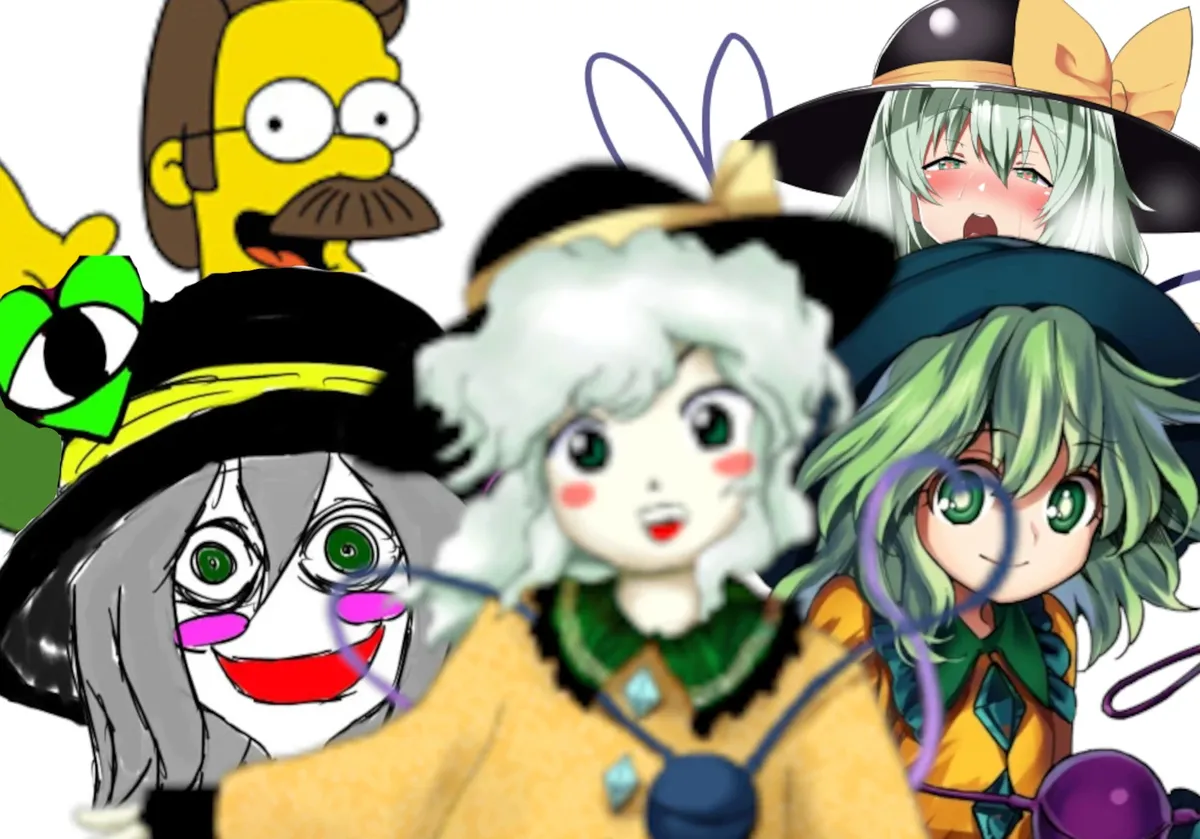
Koishi’s personality trait as defined in Subterranean Animism lines up perfectly with this. She’s utterly harmless but has an unsettling power that she may or may not even be aware of. This character trait sometimes gets exaggerated in fandom where Koishi becomes comically unaware of her surroundings to the point where she comes off as an idiot, a la ‘flanderization’ which is a very important topic surrounding this particular character.
This isn’t a universally accepted portrayal though, as there is another side of the character that is explored more frequently in comparison. And, in spite of what one may argue, is far more important when observing the global audience's response to the character.
Touhou is horror
Mythological stories are a great way of explaining how the world works without sounding like the most blocked asshole you could think of on social media, but most of the time it’s to scare your children from not bumbling off into the woods and dying to some poisonous berries or a mountain lion. Japanese folklore typically include youkais of various kinds which are referenced in great detail in Touhou, and that also includes the most unsavory bits.
As much as a lot of the youkai are a bunch of scrimblos, most of them still attack, kill, and even eat humans. It’s just that ZUN’s approach to writing dialogue for them tends to give off a more passive-aggressive attitude rather than outright violent hostility. Nothing about Touhou is explicitly horror, but this hasn’t stopped some fans from taking those darker themes and running with it like they got a plane to catch at Isle de YouTube Theory Essay.
Koishi, out of most other characters in this franchise, greatly appeals to a lot of people who subscribe to the horror genre in several different flavors. If you’ve explored this circle before you’re probably familiar with “Koishi Komeiji’s Heart-Throbbing Adventure”, a horror web series by Sentaku-bune.
This series is, honestly, insane to the point of being endearing and needs its own dedicated page otherwise I’m going to need you to come back with food & drink before you finish reading this. Basically, Koishi along with the vast majority of its characters are violent exaggerations of themselves with the story frequently jumping between disturbing the viewer and making crazy hype moments and aura. I emotionally cannot bring myself to dislike it, it’s fanfiction distilled in its purest, zany form.
Outside of Heart-Throbbing Adventure directly influencing Koishi’s fandom, her character lends itself to more subtle psychological horror that takes advantage of her manipulation of the unconsciousness. The very idea of this girl’s existence pretty much gas-lighting your own mind is unsettling enough that horror thrill-seekers subsequently fell in love with her. You could probably count the many edits of her in the Backrooms with both of your hands.
This is a very interesting take on Koishi for me because I find the idea of this harmless girl just co-existing in a genre of manmade horrors beyond comprehension really funny honestly. While Heart-Throbbing Adventure Koishi leans heavily on the blood & gore shock horror, there are also a couple other Koishi’s out there who are just playfully teasing ghost hunters even if it’s not intentional.
What’s fascinating though is that it appears these portrayals may end up having effects on official works. Koishi’s only other appearances in official Team Shanghai Alice/ZUN media are spin-offs and other bits such as books or manga. But probably her most important one outside of her debut game is Urban Legend in Limbo, one of the fighting games Team Shanghai Alice and Twilight Frontier, a doujin game development studio, had collaborated on.
Koishi is a playable character in this game and is fairly infamous too for having the unique mechanic of essentially having to 'think' about actually performing her inputs, creating a fighter that is both comically unwieldy for the player and dangerously unpredictable for the opponent. In her scenario, Koishi is having fun with her manipulation of the unconsciousness to scare people loosely on a Japanese urban legend involving a telephone and a knife, which naturally has no effect in scaring the inhabitants of Gensokyo because they don’t know what a phone is. Go figure.
Urban Legend in Limbo came out roughly six years after the first part of Heart-Throbbing Adventure was released, so people seemed to already be somewhat familiar with the creepy side of Koishi and I don’t think it’s a bad assumption to think the developers of that game ran with it to make a goofy scenario. It certainly helped further shape that image at least.
Touhou is ecchi?
When almost all of your characters are exclusively cute girls you’re going to attract more than a couple people who want to see what their bosom looks like or what kind of noises they make in bed. Pornography, especially that of fiction, is a natural state of the internet and trying to fight against it is just performative shadowboxing to get people to like you. Or you’re probably hiding something that you really don’t want the public to find out about. Most of the time it’s the latter.
… Okay, turns out it’s all the time, who’da thought?
I don’t have a lot to go over here on the whole character side of things. Koishi is sometimes depicted as an airhead (or a sociopath) and sometimes that awakens one’s feelings towards that specific character or personality trait. I prefer my women to be more of the Aya Shameimaru flavor of eccentricity, but each to their own I guess.
What I’m primarily focused on here is character design. As this is a video game character that you see on the computer screen with your eyeballs, you can’t really imagine what they would look like if you already know what they look like. Or can you?
Obviously people give Koishi black thigh-highs and an hourglass body as a means of eye candy rather than anything that they could even pretend would be lore accurate. Not gonna lie if I had a rack like that I would also break character to show all that off. I mostly want to talk about her hair style, as this is probably the single biggest variable of this character.
You see, ZUN’s official art of the character depicts her with curly hair, but most of the time artists give her a messy bob cut. So what’s going on here? Well, for better or for worse, Touhou is inconsistent from a design perspective. ZUN has a very unique style that separates it nicely from stereotypical anime art but I’m also convinced that he draws purely out of vibes because sometimes defining character features get dramatically altered, and this has had a cascading effect of people trying to figure out if Reimu’s gohei should be like a tiny little wand or a massive polearm. And in situations where official work gets passed onto another team, those artists would inject their own stylization onto the characters which can also massively alter a character’s design.
I think this right here is the nexus where people just cannot really decide who Koishi is supposed to be. When you have people twisting the defining traits all the way down to the hair on her head it almost feels like you’re making a palette swap and calling it an original character. Of course, that is nowhere near a fair comparison and I may even argue that claiming mischaracterization is failing to see the forest from the trees when you’re talking about something as creatively fluid as Touhou.
Hi-diddly-ho, shrine maidorino!
“Mischaracterization” is an ugly word used to describe poor writing as a misunderstanding of what the characters would say or do in whatever story they were put in. As great of an example as he is, talking about Soni* discourse is the fastest way to have someone lose all interest in what you’re saying right next to teaching about business & finance, so allow me to pull another similar terminology to get my point across: flanderization.
Flanderization is the gradual simplification of character traits over a long period of time that would erode them from a believable or relatable person into a one-dimensional, stereotypical caricature. It is directly named after the character Ned Flanders from The Simpsons, who is described by the original showrunners as a well-meaning, idealistic neighbor who directly contrasts Homer Simpson’s role.
Eventually, the writers became hyper-focused on his more minor characteristics, such as his devotion to Christianity, for the sake of coming up with more gags for a television series that has been airing for the last 36 years. The character had ended up devolving into just “the guy who is really religious about everything,” in which fans of the series were quick to critique about and coin the term ‘flanderization’ as this writing phenomenon became more apparent with other Simpsons characters, as well as within other long-running works.
Honestly, beyond the golden era seasons in which 95% of people had already seen and over half of that number can quote from memory, I have not sat down and watched to completion what is considered a modern Simpsons episode. Forever shows are not my thing, I already have video games wasting my time. I think having Ned being a guy of faith while simultaneously owning an emporium for left-handed people is the funniest joke they’ve done for that character and it’s really strange how much the writing cratered for him to end up getting his very own internet nerd word.
But this word and others like it gets tossed around a lot for all kinds of creative mediums that even your silly fanfiction are subject to “professional” review as if you’re a showrunner of a TV show that should’ve ended twenty years ago and probably have no contingency plan for when your voice actors eventually kick the bucket. And from second-hand experience this seems to be more than a rough juxtaposition between real script writing and a boring evening with a computer.
Everyone has their own interpretations, but god forbid someone may have a different, opposing interpretation otherwise you might have to spend the rest of your lunch break in keyboard combat with strangers who would rather tell other people how to write instead of, you know, writing themselves. It’s one thing with something like a fully published video game or television show; the scale of both of these are so grandiose that telling someone “if you hate it so much, why don’t you make your own” seems more like a politer way of just telling someone to go soak their head. But I see something like Heart Throbbing Adventure, or even just actual bad fanfiction, and it’s like how are you not just kicking sand in someone’s face for enjoying themselves with a franchise in their own unique way? Has cringe culture inflicted so much permanent damage on the online landscape that parody cannot also be art? Because this is how you get a fandom that feels more like a mock trial than a book club.
Koishi is Koishi
Koishi is frequently referred to as the most mischaracterized 'touhou' (noun for Touhou girls) in the whole franchise, which I think is a woefully reductive analysis as this clash of ideas is almost the whole point of the character. It’s human nature to try and create logical reasoning out of the inexplicable. If she literally cannot even think for herself then people will just do the thinking for her.
She’s a lovely girl who just didn’t quite understand the ramifications of her powers. Or she’s an unpredictable knife-wielding maniac that cannot be reasoned with. But, we know for absolute certainty, Koishi is Koishi; the fact that these radically different perspectives are of one single character out of the several dozen in this series is kind of an artistic achievement that should be appreciated rather than debated.
Koishi isn’t even my favorite character in Touhou, you could probably guess who tops that list if you take one look at my Bluesky page, but I was compelled to write this because she is a deeply misunderstood character. I honestly feel bad for all the Koishi warriors out there who get punched down by everyone else because people have their own ideas on what Touhou is. Someone probably read through this entire thing and is now so mad they’re standing out of their chair and yelling “who does this tourist think he is, talking about my fandom?”
But what can ya do? It’s the internet after all: “Everyone is stupid except me.”
Lozzy is a gaming enthusiast who gets all his news from a reliable source: the Bunbunmaru Newspaper. Find me on Bluesky.